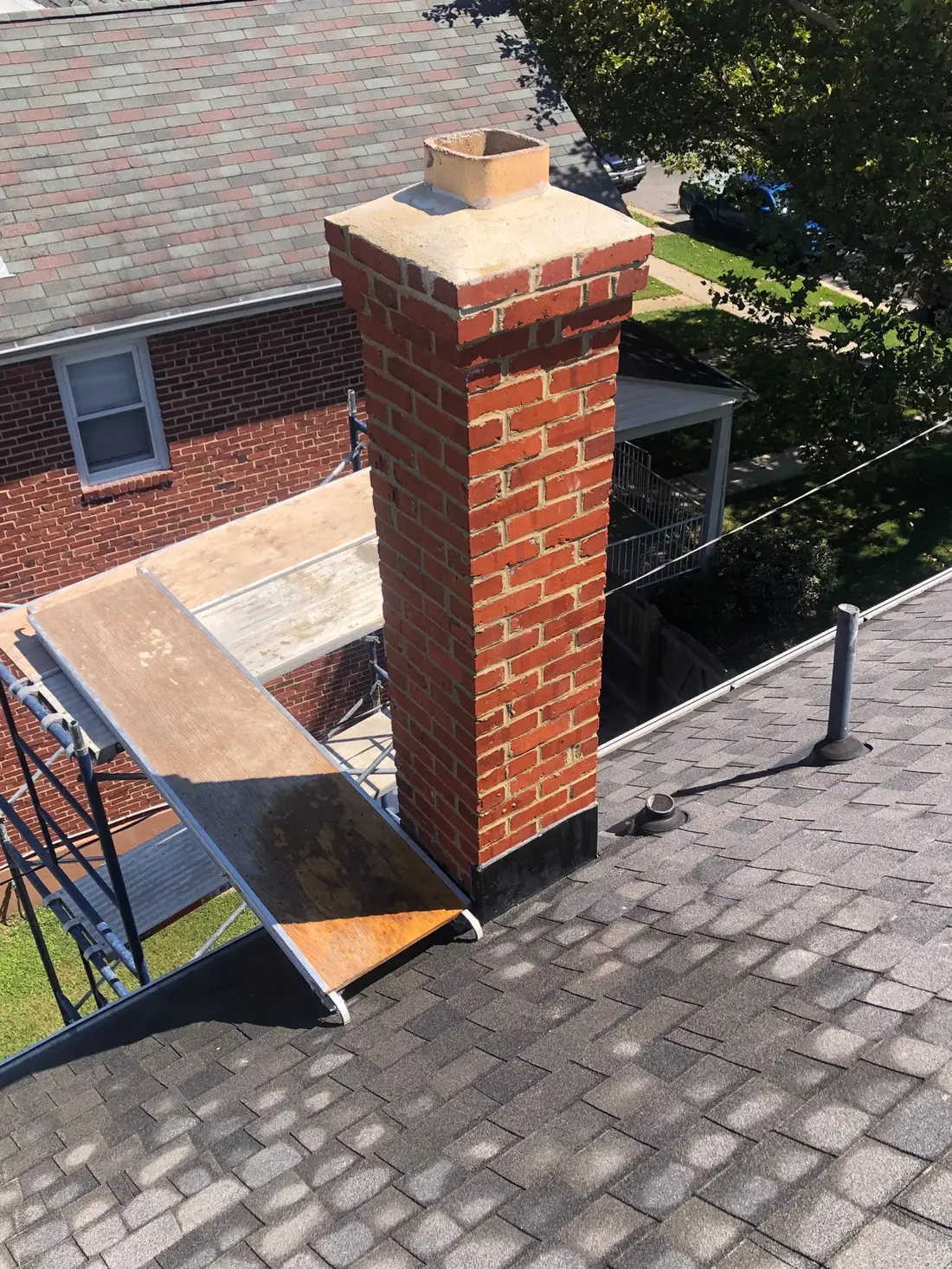
How chimney masonry fails
The pattern is consistent enough to read like a diagnosis chart. Water enters — through a cracked crown, a missing cap, porous brick, or joints whose mortar has softened to sand. Saturated brick then meets winter: the water inside it freezes, expands, and pops the face off the brick — spalling. Each spalled brick holds more water; each winter takes more face. Meanwhile the mortar joints, designed to be the sacrificial layer, erode until the stack's courses loosen and the chimney begins, very slowly, to come apart. Inside, the same water rusts the damper and the lintel and stains the firebox. Almost every expensive chimney rebuild we perform began as a cheap repair — a crown that needed sealing, joints that needed repointing — deferred until the damage compounded. The signs your chimney needs repair are mostly visible from the ground, if you know where to look.
Repointing: the repair that saves chimneys
Repointing (tuckpointing) is the removal of deteriorated mortar to a sound depth and its replacement with new mortar matched to the original in strength and appearance. It is unglamorous and it is the highest-value work in the trade, because joints are meant to wear so bricks don't have to — renewing them on time resets the chimney's clock. The craft is in the details: grinding out joints without damaging brick edges, matching mortar hardness to the brick (modern hard mortar in soft old brick cracks the brick instead of flexing), tooling the joint profile to shed water, and staging the work on tall stacks safely. A repointed chimney with a sound crown and cap is defended at every point water used to enter. Done when the joints first open up — mortar recessed, sandy, or missing in patches — it is maintenance. Done after a decade of neglect, it is rescue.
Brick, crown and structural repair
Spalled and cracked bricks are cut out and replaced with matched units — a chimney is repaired with brick that belongs on it, not whatever was on the truck. Crowns — the concrete cap that seals the top of the masonry — are repaired where cracking is shallow and rebuilt where it is not, formed with the slight overhang and slope that sheds water off the stack instead of into it; crown work pairs naturally with the cap and crown service on our caps & crowns page. Flashing failures — the metal seal where chimney meets roof, and the cause of a large share of "chimney leaks" — are renewed as part of roofline repairs when the leak's source is the joint rather than the masonry. And when a chimney has deteriorated past saving in place — leaning, bulging, or crumbled through whole sections — the honest answer is a rebuild: the stack taken down to sound material (sometimes to the roofline, sometimes below it) and relaid properly, with a new crown and a liner inspection worked into the same project.
Firebox repair and rebuild
The firebox endures the harshest cycle in the house: direct flame heat, then cooling, hundreds of times, in brick and mortar that were never meant to last forever. Firebox mortar joints crack and recess; firebrick spalls and crumbles; in prefab fireplaces, the refractory panels crack and thin. We repair fireboxes by repointing with refractory mortar rated for the heat, replacing failed firebrick, and renewing panels in prefab units — and we rebuild fireboxes whose structure has gone beyond joint repair, restoring the correct firebox geometry (its shape is not decorative; it is what makes the fireplace draft and radiate properly). A firebox in poor condition is also a finding with a safety edge: gaps in the firebox wall are paths for heat toward framing, which is why firebox condition is part of every inspection we perform.
How quoting works — in writing, with photos
Masonry is quoted from evidence, not from a ladder-side impression. After an inspection or a repair assessment, you receive a written scope: the areas to be repaired, the method, the materials, and the price — with photographs of the damage being quoted. Scaffold needs, stack height and access are part of the scope, not surprises added later. Work is staged so you can approve phases: stop the water this season (crown, cap, joints), rebuild next season, if that is what your budget calls for — we will tell you plainly which order the chimney's condition demands, and which items genuinely cannot wait because they guard the structure or the flue's safety.
What good masonry buys you
A chimney maintained at the joint-and-crown level lasts generations — there are two-hundred-year-old stacks standing because somebody repointed them every few decades. The economics are not subtle: repointing costs a fraction of rebuilding, and rebuilding costs a fraction of the water damage a failed chimney does to roofs, ceilings and framing while everyone is watching the wrong problem. Our job is to tell you where on that curve your chimney actually stands — with the camera and the photographs to prove it — and to do the work at the level the evidence supports. No more, and no less.